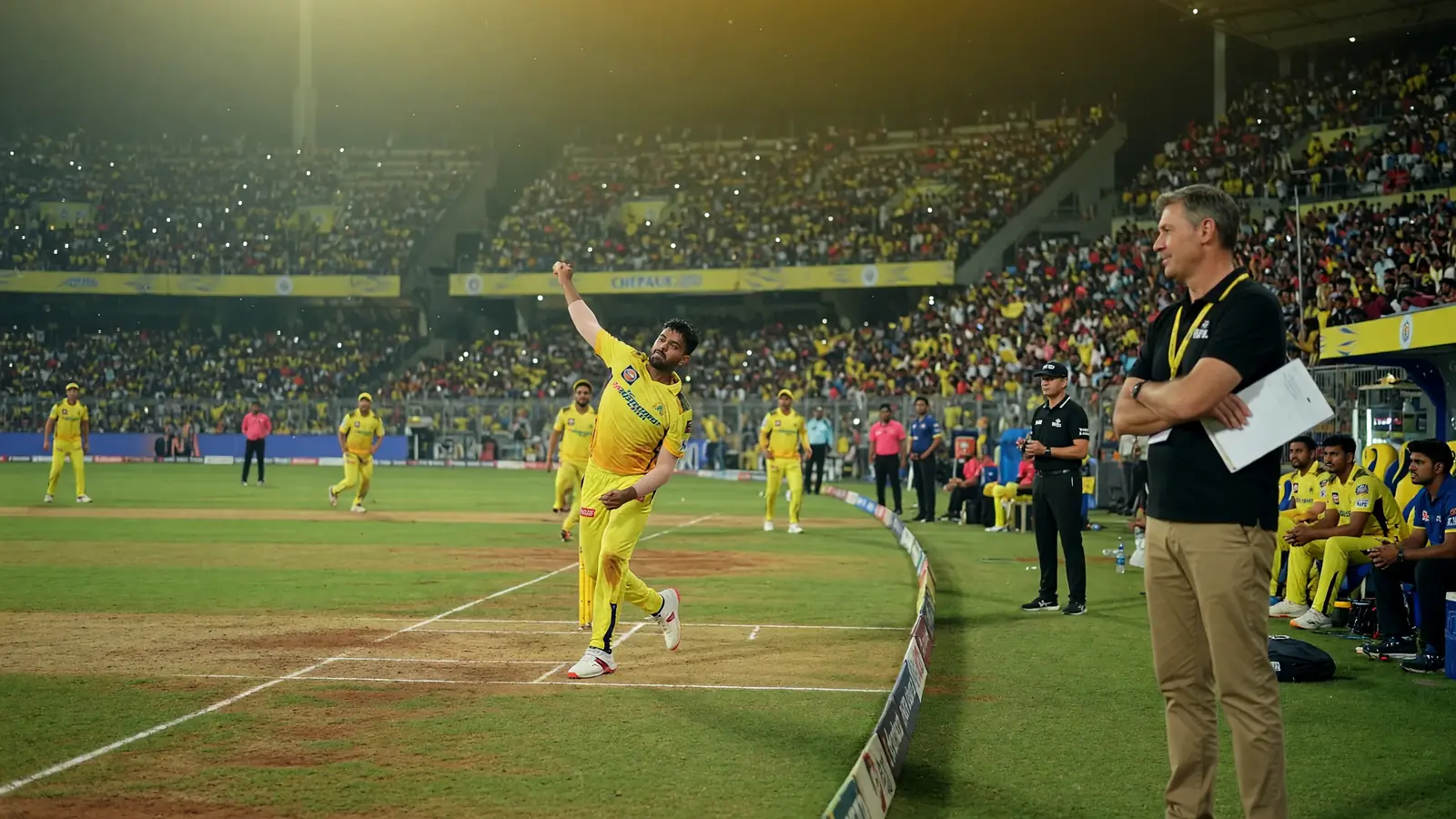
Left-arm pacer Gurjapneet Singh has publicly credited former Chennai Super Kings coach Stephen Fleming for creating a pressure-free environment that helped him grow through IPL 2026. The comments came on 1 August 2026, on the sidelines of the Madurai Panthers jersey launch for the Tamil Nadu Premier League, and they frame Fleming less as a slogan coach and more as a steady presence in a high-noise franchise room.
Gurjapneet, 27, said he worked with Fleming for two years and found him calm and easy to talk to even when results were going against the side. That is not a generic thank-you. For a young pacer still establishing a clear IPL role, the difference between a coach who tightens the room after a loss and one who keeps communication open can decide whether a bowler keeps trusting his stock ball or starts forcing wicket balls he does not own.
What Gurjapneet said about Fleming
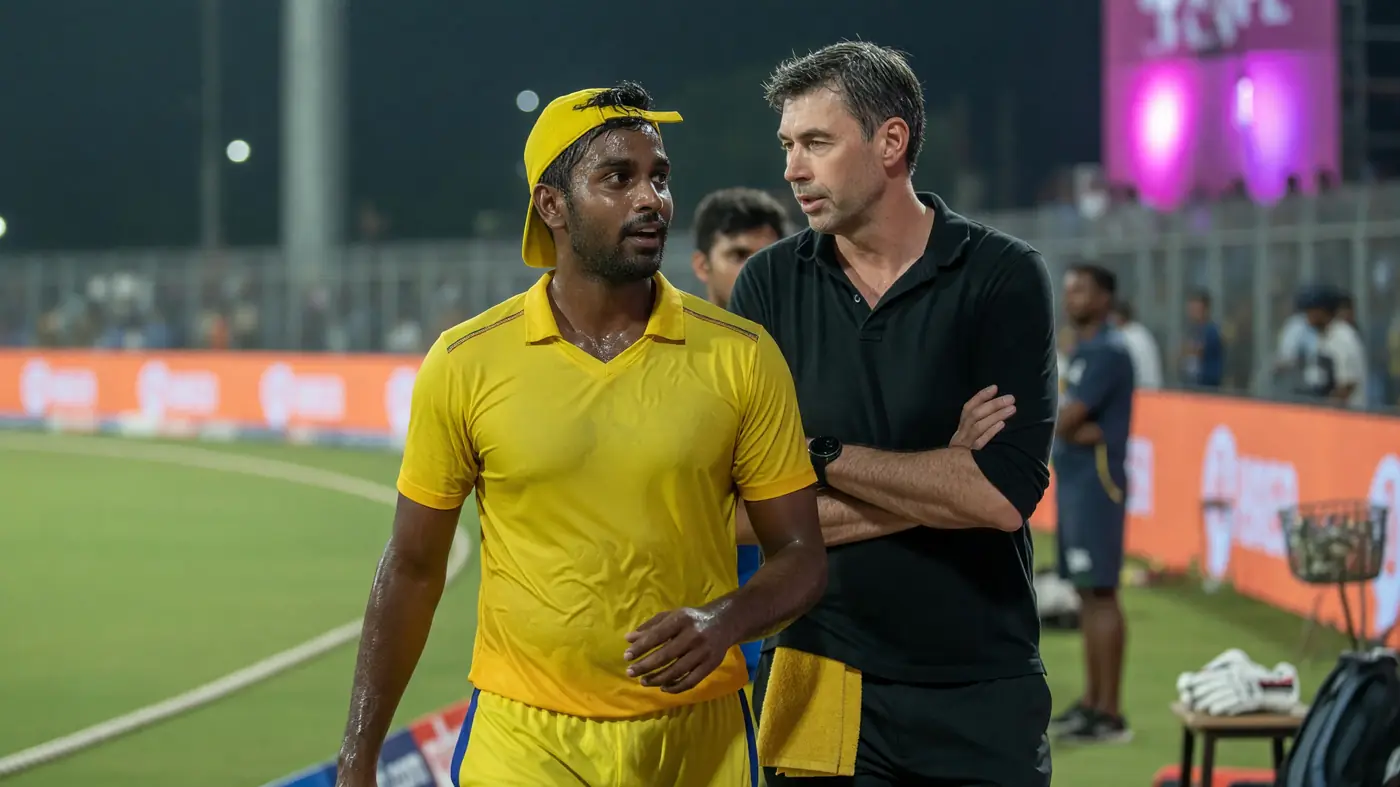
Gurjapneet's core description of Fleming was personal rather than tactical. He said the coach stayed calm, stayed approachable, and did not load extra pressure onto players when the team was losing. In his words, losing spells usually make it hard to talk to a coach because everyone is under pressure; Fleming, he said, was different.
That remark lands because IPL dressing rooms compress everything. A poor over can sit beside a table of franchise owners, a live television panel and a captain still solving the next matchup. Gurjapneet's point was not that Fleming ignored performance. It was that the coach left enough air for a conversation after bad nights, which is often when young bowlers either recover their process or start chasing validation with every delivery.
He also went further than mood management. Gurjapneet said Fleming had an "X-factor" that helped CSK collect five IPL titles under him, and that the coach left plenty to the player after identifying potential. Freedom, in his telling, was not a vague culture phrase. It was the space to keep practising what he already did well instead of reinventing his game every week to match external noise.
The eight-match IPL 2026 sample
The hard numbers attached to the season are modest and should be read as such. In IPL 2026, Gurjapneet played eight matches and took four wickets at an average of 58.25 while Fleming was still coaching CSK. That is not a breakout wicket haul. It is a limited sample that still placed him inside the match-day group often enough for the relationship with the coach to matter.
For fantasy and team-sheet readers, the useful takeaway is not to inflate four wickets into a finished product. It is to separate opportunity from output. Eight appearances mean Gurjapneet was trusted in enough XI combinations to accumulate real match experience under Fleming and M.S. Dhoni. Four wickets at 58.25 mean the returns lagged behind the trust, which is exactly why his comments about role clarity and pressure management are more revealing than a raw leaderboard rank.
Readers following IPL 2026 news and analysis should treat the sample as a development window rather than a finished ranking. A left-arm pacer can be valuable in an IPL attack without topping the wicket chart if he holds a lane, hits a hard length, and lets a faster partner create the wicket ball from the other end. Gurjapneet's own remarks about Jamie Overton point in that direction.
Practise strengths, then deliver
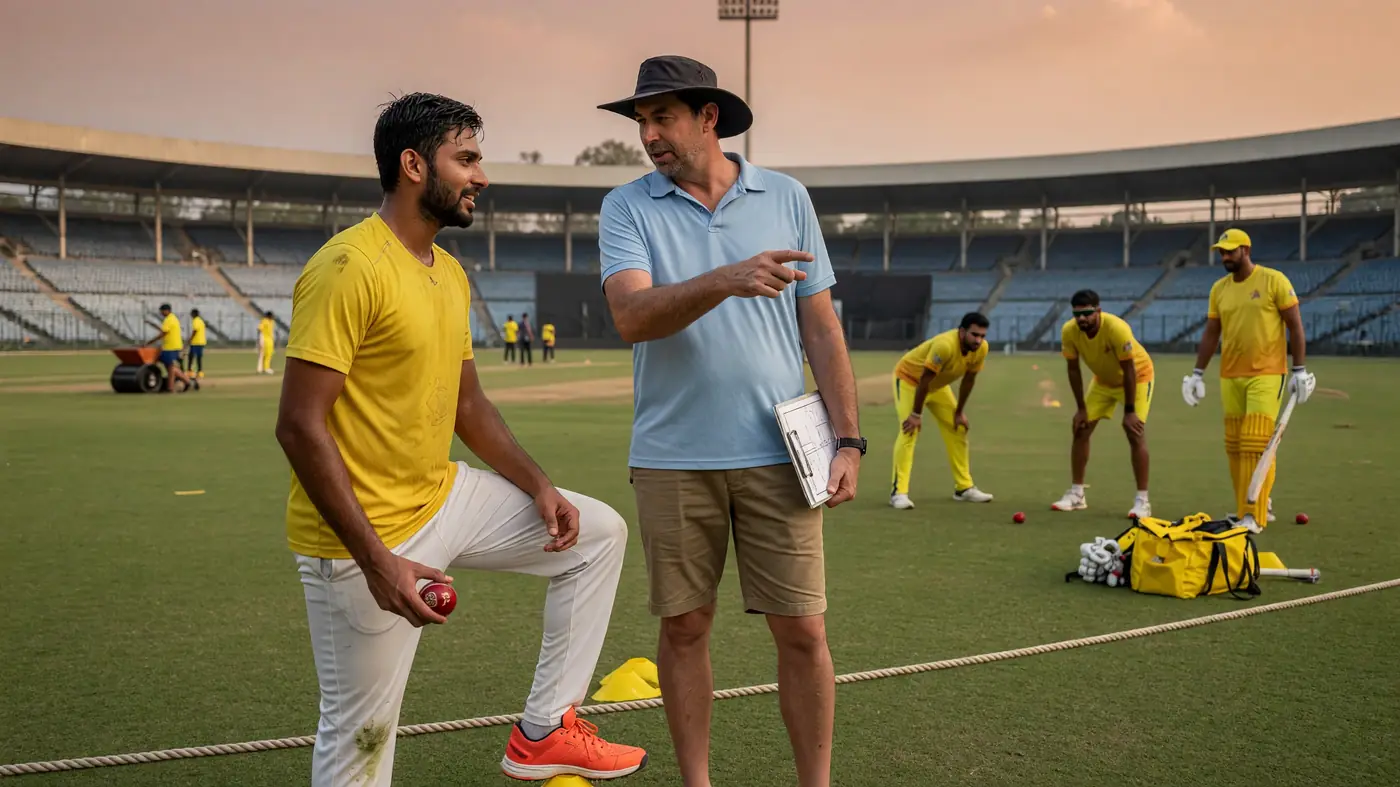
The clearest coaching instruction Gurjapneet repeated was simple. Fleming told him to keep practising his strengths, gain confidence in the nets, and then deliver in the match. He said that is what he tried to do. There is no jargon in that sequence, and that is probably why it stuck.
Many young IPL bowlers reverse the order. They watch an opponent smash a short ball on television, then arrive at training determined to invent a new variation before they have stabilised the ball they already own. Fleming's advice, as Gurjapneet relayed it, pushed the opposite habit: identify the skill that travels under pressure, groove it until the body trusts it, and only then ask the skill to hold up on match night.
That method also explains why Gurjapneet emphasised freedom. A coach who keeps adding new fields, new grips and new identity labels every fortnight can make a developing pacer feel permanently behind. A coach who first locks the player's best ball gives the player something concrete to return to after a rough over. Gurjapneet presented Fleming as the second type.
Practise the strength already present → build confidence in training → carry that same ball into the match. He did not describe Fleming as a coach who reinvented him from scratch; he described a coach who protected the skill he already had.
How Fleming and Dhoni used bowlers
Gurjapneet also highlighted the understanding between Fleming and M.S. Dhoni. According to the pacer, the pair used bowlers in roles that best suited their strengths. That is a more operational claim than praise for dressing-room mood. Role design is where coaching and captaincy either waste a bowler or multiply him.
In practical terms, role fit for a left-arm pacer can mean a defined over window, a preferred matchup lane, and a clear brief on whether he is there to dry one side, attack a right-hander, or hold a middle-overs pocket while a strike bowler hunts from the other end. Gurjapneet did not publish a ball-by-ball map of his own overs. He did say the Fleming-Dhoni combination tried to put bowlers where their skills made sense, which is consistent with CSK's long reputation for using specialists rather than forcing every quick into the same death-overs template.
For a 27-year-old still stacking IPL reps, that matter more than a single wicket column. A bowler who knows why he is bowling the third over or the twelfth over can prepare a smaller, sharper toolkit. A bowler who is thrown into whatever over is left after a collapse ends up solving problems he never trained for. Gurjapneet's account suggests Fleming and Dhoni tried to reduce that chaos.
Bowling with Jamie Overton
On the field, Gurjapneet pointed to the CSK pace group and specifically to Jamie Overton. He said Overton bowled very quickly from one end, which allowed the unit to build pressure together. When one bowler was creating pressure, he said, the other was taking wickets.
That is a classic complementary-pace description. Express pace at one end changes the batter's timing and shot selection; a partner who holds a hard length or attacks a different channel can then collect the mistake. Gurjapneet did not claim he was the sole beneficiary. He framed Overton's speed as a collective advantage for the pacers around him.
Read beside his coaching comments, the Overton point completes the picture. Fleming's calm and Dhoni's role clarity only work if the attack itself has complementary tools. A pressure-free environment does not create wickets by itself. It keeps a bowler clear enough to use the pressure another teammate is generating. Gurjapneet's version of IPL 2026 is therefore both interpersonal and structural: a coach who did not panic him, a captain-coach pairing that placed him in sensible roles, and a pace partner whose speed made those roles more profitable.
Fleming's CSK record and England move
The broader backdrop to Gurjapneet's praise is Fleming's long CSK tenure. Fleming spent 14 seasons as CSK coach and won seven trophies, including five IPL titles, before taking the England men's Test coaching job. Gurjapneet's "X-factor" line sits on top of that record rather than replacing it.
Five IPL titles under one coach do not prove every squad member thrived the same way. They do explain why a young Indian pacer would treat Fleming's methods as more than temporary mood music. When a coach leaves after that span, players often sort themselves into two groups: those who mainly remember the trophies, and those who can name a concrete habit the coach left behind. Gurjapneet named a habit — protect your strength in practice, then trust it in the middle — and a feeling — you could still talk to the coach after a loss.
Fleming's move to England also freezes the relationship in time. The IPL 2026 sample Gurjapneet discussed is now a closed chapter under that coach. Whatever he carries into future CSK seasons, TNPL weeks or any later franchise stint will be an echo of those two years rather than an ongoing daily dialogue with Fleming in the same yellow room.
| Item | Confirmed detail |
|---|---|
| Player | Gurjapneet Singh, left-arm pacer, age 27 |
| Franchise context | Chennai Super Kings in IPL 2026 |
| Coach credited | Stephen Fleming, former CSK coach |
| Working relationship | Two years with Fleming |
| IPL 2026 sample | 8 matches, 4 wickets, average 58.25 |
| Captain link | Fleming and M.S. Dhoni used bowlers to their strengths |
| Pace partner named | Jamie Overton, express pace from one end |
| Fleming CSK tenure | 14 seasons, 7 trophies, 5 IPL titles |
| Fleming next role | England men's Test coach |
| Remarks setting | Madurai Panthers TNPL jersey launch |
Why the Madurai Panthers launch mattered as a setting
The remarks were not made in a post-match flash interview or a CSK media day. They came beside Gurjapneet's TNPL franchise Madurai Panthers jersey launch. That setting matters because it places the comments in a domestic, player-owned moment rather than a franchise victory-lap. He was launching a state-league identity while looking back at an IPL season that had already given him eight games under one of the league's most decorated coaches.
TNPL weeks often become the place where Indian quicks reset their workloads, reclaim overs, and speak more freely than they do inside the IPL bubble. Gurjapneet used that space to talk about process instead of scoreboard defence. He did not try to re-litigate every IPL spell. He explained how he was coached, how roles were assigned, and how a fast teammate made the unit function.
For readers who track state-league form as a bridge between IPL seasons, the launch is also a calendar marker. Gurjapneet is not only a CSK squad name in this window; he is an active TNPL pacer with a public account of what he thinks good coaching looks like. That combination — recent IPL exposure plus a clear self-description of method — is more useful than either detail alone.
What to watch next for Gurjapneet
The next clean checkpoint is not another retrospective quote. It is whether Gurjapneet continues to receive defined overs in competitive cricket and whether the bowling average from his eight-match IPL 2026 sample starts to move as he stacks more games. The Sportstar conversation freezes Fleming's influence as a completed coaching relationship; the bowling work now has to stand without that daily presence.
In the short term, his Madurai Panthers TNPL workload is the most immediate stage on which to watch role clarity. If he is used in a stable lane — rather than shuffled through random overs — the Fleming-Dhoni lesson he described will still be visible even after Fleming's exit to the England Test job. In the longer term, any later IPL selection will be judged against a simple question his own numbers already pose: can the trust of eight appearances turn into a sharper wicket column than four at 58.25?
Gurjapneet did not sell IPL 2026 as a finished breakout. He sold it as a season in which a calm coach, a captain who matched bowlers to strengths, and a high-pace partner gave him room to grow. The sample remains small. The coaching detail is specific enough to matter.
FAQ
What did Gurjapneet Singh say about Stephen Fleming?
He said he worked with Fleming for two years and found him calm and easy to talk to, even when CSK were losing, because Fleming did not put pressure on players.
How many wickets did Gurjapneet take in IPL 2026 under Fleming?
He played eight matches and took four wickets at an average of 58.25.
Where were the comments made?
On the sidelines of the Madurai Panthers TNPL jersey launch.
What coaching advice did Fleming give him?
Fleming told him to keep practising his strengths, gain confidence in practice, and then deliver in the match.
How did Jamie Overton feature in his account?
Gurjapneet said Overton's pace from one end helped CSK's pacers build pressure together, with one bowler creating pressure while the other took wickets.
What is Stephen Fleming's CSK coaching record as cited here?
Fourteen seasons as coach, seven trophies in total, and five IPL titles before he moved to coach England's men's Test side.
Source note: Facts in this piece are drawn from Sportstar reporting dated 1 August 2026 by S. Prasanna Venkatesan on Gurjapneet Singh's remarks about Stephen Fleming. Confirmed details include the two-year working relationship, Fleming's calm pressure-free approach, the IPL 2026 sample of eight matches and four wickets at 58.25, Fleming's instruction to practise strengths before match delivery, the Fleming-Dhoni role-fit approach to bowlers, Jamie Overton's pace partnership, Fleming's 14-season CSK tenure with seven trophies and five IPL titles, his move to the England men's Test job, Gurjapneet's age (27), and the Madurai Panthers TNPL jersey launch setting. No additional match figures, unpaid quotes or squad decisions have been invented.
Responsible play: sports club publishes editorial coverage for adult readers in India. Paid fantasy contests may be restricted in some states. Check current app eligibility before entering any paid contest. If play stops being fun, stop. Helpline: iCall 9152987821 (10am–6pm Mon–Sat) · Gambling Therapy India.